
Towards an early-warning system for food insecurity in Brazil: Forecasting vulnerable households using national survey data
Autor: Igor Ferrão and Ricardo Campante Vale
Áreas Temáticas Políticas de Redução da Pobreza
Compartilhe este conteúdo em suas redes
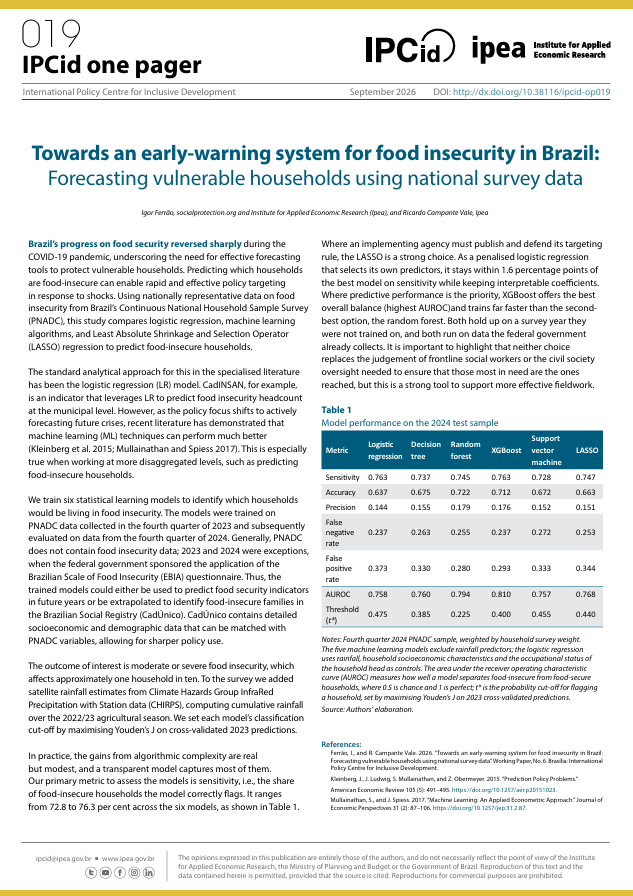
Resumo: Brazil’s progress on food security reversed sharply during the COVID-19 pandemic, underscoring the need for effective forecasting tools to protect vulnerable households. Predicting which households are food-insecure can enable rapid and effective policy targeting in response to shocks. Using nationally representative data on food insecurity from Brazil’s Continuous National Household Sample Survey (PNADC), this study compares logistic regression, machine learning algorithms, and Least Absolute Shrinkage and Selection Operator (LASSO) regression to predict food-insecure households.